Updated September 2026 · 9 min read
Quick answer
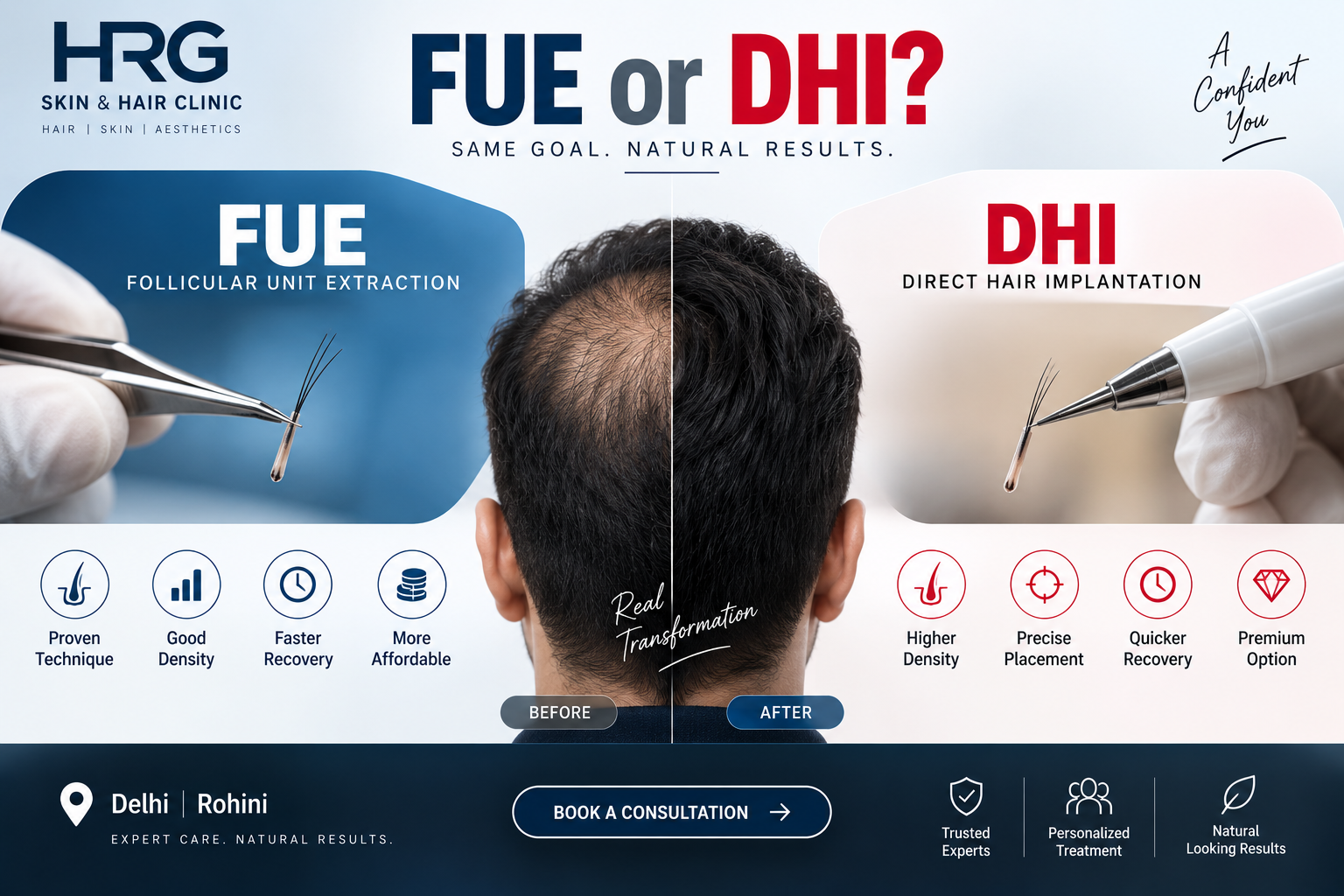
DHI is better for the frontal hairline, temples and adding density between existing hair. FUE is better for large bald areas and the crown. Both use the same extraction method and give permanent results. For most men with moderate to advanced baldness, a combined plan (DHI at the hairline, FUE behind it) gives the best result for the money.
Search for the best hair transplant clinic in Delhi and within five minutes you will see the same two letters on every website: FUE and DHI. One clinic calls DHI the "most advanced method". Another says FUE is the "gold standard". Both are selling something, and neither tells you the one fact that decides the question: the right technique depends on which part of your head is being treated, not on which technique sounds newer.
This guide explains what actually happens in each procedure, where each one wins, where each one wastes money, and what to ask before you sign anything, whether you choose HRG Clinic or any other clinic for your hair transplant in Rohini or Delhi.
In this guide
1. What FUE and DHI really are (and the part most clinics skip)
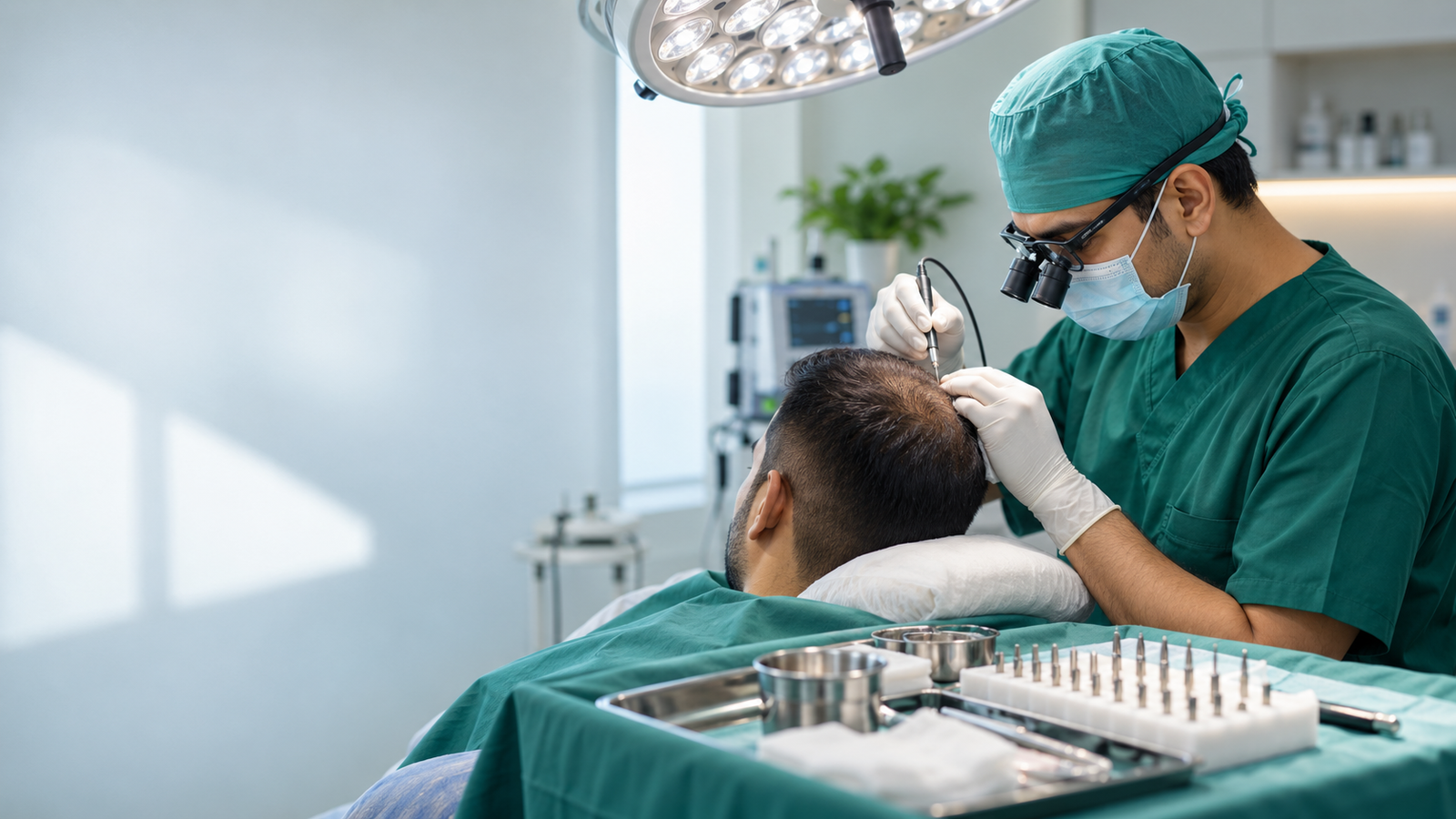
Every hair transplant has two stages: extraction (taking follicles out of the donor area at the back and sides of the head) and implantation (placing them into the thinning area).
FUE (Follicular Unit Extraction) removes follicles one by one with a micro-punch, usually 0.7 to 1 mm wide. The surgeon then opens tiny channels in the recipient area with a fine blade or needle, and the grafts are placed into those channels with forceps. Sapphire FUE is the same process with a sapphire blade used for the channels.
DHI (Direct Hair Implantation) extracts follicles in exactly the same way. The difference is only in implantation: each graft is loaded into a Choi implanter pen, which creates the opening and places the graft in a single movement, at a set angle and depth.
"DHI is not a different transplant. It is a different way of putting the graft in. Once you understand that, most of the marketing noise disappears."

2. FUE vs DHI: side-by-side comparison
| Factor | FUE | DHI |
|---|---|---|
| Extraction | Individual follicles with micro-punch | Same as FUE |
| Implantation | Channels opened first, grafts placed with forceps | Implanter pen opens and places in one step |
| Best suited for | Large areas, crown, higher grade baldness | Frontal hairline, temples, density in small zones |
| Grafts in one sitting | Higher, suits large coverage | Usually lower, slower per graft |
| Shaving of recipient area | Usually required | Often possible without shaving |
| Control over angle and depth | Good, depends on surgeon skill | Very precise, built into the pen |
| Cost per graft | Lower | Higher |
| Recovery | Scabs clear in about 7 to 10 days | Similar, sometimes slightly less redness |
| Final result visible | 12 to 18 months | 12 to 18 months |
Want to know what each option costs for your graft count? Read our breakdown of what really decides hair transplant cost in Delhi.
3. Where DHI genuinely earns its premium
The frontal hairline is the part of your head people see at conversational distance. It has to look soft, irregular and dense, with single-hair grafts at the front and the angle of every hair matching your natural growth direction. The implanter pen gives the surgeon very fine control over angle and depth, and it allows grafts to be packed closely between existing hairs without damaging them.
DHI makes the most sense if you:
- have early or moderate recession at the hairline and temples (roughly Norwood grade 2 to 3; see our Norwood scale guide)
- want to add density in between existing hair rather than cover a bald zone
- cannot shave your head completely because of work or personal reasons
- are a woman with diffuse thinning along the parting or hairline (read about hair transplant for women)
4. Where FUE is the smarter choice
The crown and mid-scalp need coverage, not the sharpness of a hairline. Spending DHI rates on 2,000 grafts for the crown is usually a poor use of both your money and your donor supply, which is limited and never grows back.
FUE makes more sense if you:
- have advanced baldness (Norwood grade 4 and above) that needs a large number of grafts in one sitting
- need crown coverage
- have a strong donor area and want the maximum grafts for a fixed budget (find out how many grafts you may need)
- are fine with a short trim or shave for a few weeks
5. The answer most men actually need: a combined plan
For a large number of patients, the honest recommendation is neither pure FUE nor pure DHI. It is a combined plan: DHI for the front 1 to 2 cm of hairline where precision shows, and FUE for the mid-scalp and crown where volume matters. You pay the premium only where it changes how you look.
If a clinic quotes you 100% DHI for a Norwood 5 case without explaining why, ask them to justify it zone by zone.
6. What decides your result more than FUE or DHI
Patients spend weeks comparing techniques and ten minutes checking who is doing the surgery. It should be the other way around. The International Society of Hair Restoration Surgery (ISHRS) advises patients to confirm that a qualified physician is directly involved in their procedure. These factors decide your final density far more than the name of the method:
- Who does the implantation. Ask directly whether the doctor places the grafts or only draws the hairline. Get the answer in writing.
- How the graft count is decided. A proper scalp analysis measures donor density and hair calibre. A number quoted over the phone is a guess.
- Graft handling. Follicles outside the body must be kept in a chilled holding solution and implanted within a controlled time. Poor handling is the main cause of weak growth.
- Hairline design. A hairline drawn too low or too straight looks artificial at 45 and cannot be moved up later.
- Sterile setup. A long procedure under local anaesthesia needs a clean, properly equipped procedure room and monitoring.
- Aftercare. Scheduled reviews for the first year, first wash guidance and medical support such as PRP therapy for existing hair protect both new and native hair.
7. Recovery timeline for FUE and DHI
The recovery curve is almost identical for both techniques, because extraction is the same and both leave tiny wounds. (Full details in our month-by-month recovery guide.)
- Day 1 to 3: mild swelling on the forehead, tightness in the donor area.
- Day 7 to 10: scabs fall off after gentle washing. Most people return to desk work within a few days.
- Week 2 to 8: transplanted hairs shed. This is normal and the root stays in place. Read more about shock loss after a hair transplant.
- Month 3 to 4: new growth starts, thin at first.
- Month 6 to 8: visible change in density.
- Month 12 to 18: final result, with the crown usually taking the longest.
8. How to choose the best hair transplant clinic in Delhi
Delhi has hundreds of clinics, and many advertise the lowest per-graft rate. Price per graft is only useful when everything else is equal, and it rarely is. When you shortlist the best hair transplant clinic in Delhi for your case, check these points:
- A qualified doctor examines your scalp in person before any number is quoted.
- You receive a written plan: graft count, zones, technique for each zone and total cost.
- The clinic explains why FUE, DHI or a combined plan suits you, instead of pushing one method for everyone.
- You can see before-and-after results of patients with a similar grade of baldness, including 12-month photos.
- The quote includes medicines, the first wash and follow-up reviews, with no charges added later.
Save this checklist
Sending this to a friend or brother who is thinking about a hair transplant? Share it on WhatsApp.
9. Why patients across North and West Delhi choose HRG Clinic, Rohini
If you are looking for the best hair transplant clinic in Rohini, Delhi, the clinic you pick should be close enough for regular follow-ups during the 12 months your hair takes to grow. HRG Clinic in Sector 11, Rohini is easy to reach from Pitampura, Shalimar Bagh, Prashant Vihar, Bawana, Narela, Paschim Vihar, Janakpuri and Bahadurgarh.
At HRG, we do not decide your technique before we see your scalp. Your consultation includes a scalp and donor assessment, a zone-by-zone plan that tells you where FUE, DHI or a combined approach makes sense, and the full cost in writing before you pay anything. That is how we believe a hair transplant in Rohini should work: planned for your head, not for a package.
Frequently asked questions
Is DHI better than FUE?
Not in general. DHI gives more precise control for the hairline and for adding density between existing hair. FUE is more efficient for large bald areas and the crown. The better technique is the one that suits the zone being treated.
Which lasts longer, FUE or DHI?
Both last equally long. In both techniques the follicles come from the donor area at the back of the head, which is resistant to pattern hair loss, so transplanted hair is generally permanent.
Is DHI more painful than FUE?
No. Both are done under local anaesthesia. After the numbing injections, most patients feel pressure rather than pain during either procedure.
Can I get DHI without shaving my head?
In many cases, yes, especially for small hairline or density sessions. For larger sessions the donor area usually still needs to be trimmed.
Why is DHI more expensive than FUE?
DHI takes more time per graft, needs multiple implanter pens and a highly trained team to load and place each graft. That extra time is reflected in the price per graft.
How do I find the best hair transplant clinic in Rohini, Delhi?
Choose a clinic where a doctor assesses your scalp in person, gives you a written graft count and cost, explains the technique for each zone, shows 12-month results of similar cases and offers follow-up care through the growth period.
Book your FUE or DHI consultation in Rohini
Not sure whether you need FUE, DHI or a combination? Visit HRG Clinic for a detailed scalp assessment and leave with your graft count, recommended technique and total cost on paper.
HRG Clinic
1st Floor, C-1/167, Opposite CNG Pump, Sector 11, Rohini, Delhi 110085
Email: support@hrgclinic.com
Related reading
- Hair transplant cost in Delhi: what actually decides the price
- How many grafts do I need?
- Hair transplant recovery: month-by-month timeline
- Shock loss after hair transplant: normal or a problem?
This article is for general information and does not replace a medical consultation. Suitability for FUE or DHI can only be confirmed after an in-person scalp examination by a qualified doctor.