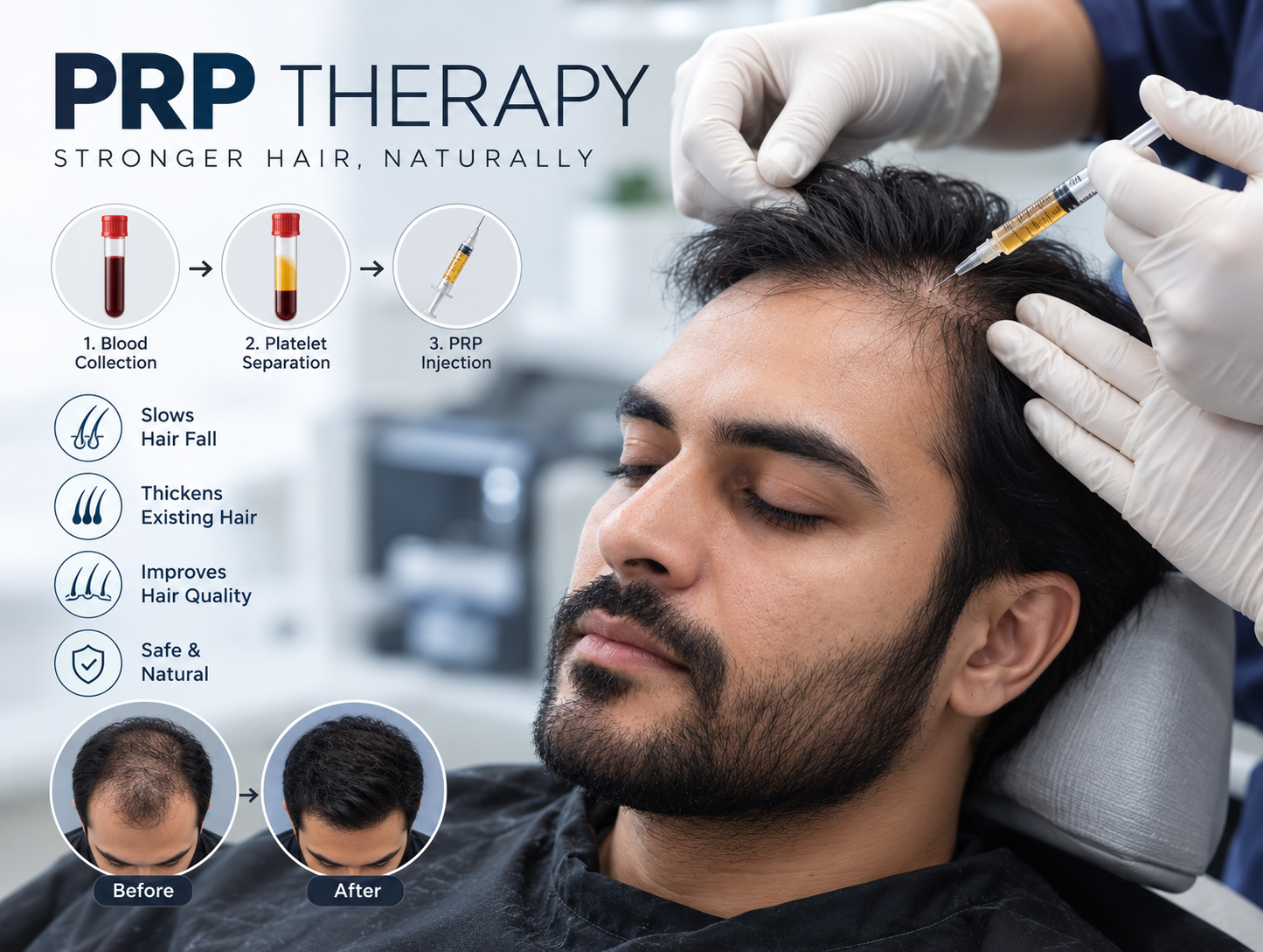
PRP therapy injects a concentrate of your own platelets into thinning areas to reduce hair fall and thicken weakening hair. Sessions take about 20 minutes with no downtime.
A small sample of your blood is spun to concentrate the platelets, and that concentrate is injected into the thinning zones of your scalp. The growth factors it carries can strengthen follicles that are weakening but still alive.
What it can and cannot do
PRP may help reduce shedding and support existing hair in some patients. It does not bring back a follicle that has already miniaturised and closed. That distinction is what your trichoscopy at consultation is for — we would rather tell you a transplant is the honest answer than sell you six sessions that will not move the needle.
Want to know what PRP Therapy would cost for you?Your plan and pricing are explained at a free consultation. EMI options are available.
On pricing: The cost depends on what your scalp or skin needs, so it is explained at your free consultation, along with what the plan includes. Results vary from person to person.
Ask HRG AI about PRP Therapy
Instant answers from the clinic's own notes. General information, not a diagnosis.
HRG AI answer
General information only. A doctor confirms what applies to you at the consultation.
PRP (Platelet-Rich Plasma) uses a concentrate of your own blood platelets, injected into thinning areas of the scalp. The growth factors can help reduce shedding and thicken hair that is weakening but still alive.
GFC (Growth Factor Concentrate) is a preparation of growth factors made from your own blood. It is used for early and diffuse thinning, usually over several sessions. Response varies from person to person.
Both come from your own blood but are prepared differently. Both are used for early thinning and response varies. Your doctor advises which suits you after examining your scalp.
No. PRP strengthens follicles that are still alive; it cannot restart follicles that have completely stopped producing hair. Bald areas need a transplant.
Reduced shedding is often noticed within 6–8 weeks, with thickness improving over three to six months. Progress is tracked with standardised photographs.