Updated October 2026 · 12 min read
Quick answer
The best hair transplant in Delhi is not decided by whether a clinic calls it FUE, DHI or Sapphire. It is decided by graft survival: how many of the grafts taken from your scalp are still alive when they are placed, and go on to grow. Survival depends on how long grafts stay outside the body, how they are stored, how gently they are handled, how cleanly they are extracted and who actually performs each step. A clinic that cannot explain these clearly is selling a graft number, not a result.
Two men walk into two different clinics with the same Norwood 4 hair loss. Both are told they need 2,800 grafts. Both pay, both go through an eight-hour procedure, and both go home with the same number written on their discharge sheet. Twelve months later, one has a full, natural hairline. The other has thin, patchy growth and is asking for a second opinion.
The graft count was the same. What was different was everything that happened to those grafts between leaving the scalp and going back into it. This guide explains those factors, the ones most clinics never talk about, so you can judge any clinic offering a hair transplant in Delhi or a hair transplant in Rohini on what actually decides your result.
The 9 graft survival factors
- Out-of-body time
- Storage solution and temperature
- Drying and handling damage
- Transection rate and punch size
- Who actually does which step
- Density and the dense packing trap
- Your lifetime donor budget
- Graft count vs hair count
- Your own health and habits
What graft survival means · Graft guide by Norwood stage · Clinic checklist · FAQs
What is graft survival, and why does nobody talk about it?
A graft, more correctly a follicular unit, is a tiny natural group of one to four hairs with its root, oil gland and a thin layer of surrounding tissue. In an FUE hair transplant, these units are taken one by one from the back and sides of the scalp (the donor area) and placed into the thinning or bald area (the recipient area).
Between those two moments, the graft is living tissue with no blood supply. It is cut off from oxygen and nutrients until it is placed in the scalp and the body reconnects it over the following days. Every minute it spends drying, warming up, being squeezed or waiting on a tray is a minute in which some grafts are lost.
Here is the uncomfortable truth: you cannot see graft survival on the day of surgery. On day one, 3,000 healthy grafts and 3,000 damaged grafts look exactly the same. The difference only shows at six to twelve months. That delay is why many clinics in Delhi advertise graft numbers and price per graft, and almost none talk about how many of those grafts survive.
"You are not paying for grafts extracted. You are paying for grafts that grow."
1. Out-of-body time
Out-of-body time is the gap between a graft leaving the donor area and entering the recipient site. It is one of the most studied factors in hair restoration, and the general finding is simple: shorter is better, and long waits are linked with lower survival.
The problem in high-volume clinics is workflow. If all grafts are extracted first and implanted afterwards, the first grafts taken can sit waiting for many hours. In a long session of 3,000 grafts or more, that wait adds up.
What a good answer sounds like: grafts are extracted and implanted in batches, recipient sites are prepared in advance, and the clinic does not book more grafts in one day than the team can place without rushing.
Watch out for: "We take out all the grafts in the morning and implant after lunch."
2. Storage solution and temperature
While grafts wait, they sit in a holding solution in a dish. What that solution is, and how cold it is kept, affects how well the cells cope without oxygen.
| Storage approach | What it means | Effect on grafts |
|---|---|---|
| Chilled saline or Ringer's lactate | Standard holding liquid, kept cold | ✅ Cold slows the graft's energy use and helps it survive the wait |
| Specialised hypothermic solutions | Solutions designed to protect cells at low temperature | ✅ Some surgeons prefer them for long sessions |
| Room-temperature dish, no cooling | Liquid warms up under OT lights | ⚠️ Warmer tissue uses up its reserves faster |
| Grafts on dry gauze or exposed to air | Grafts not fully covered by liquid | ❌ Drying is one of the fastest ways to lose grafts |
Question to ask: "What do you store my grafts in, and how do you keep them cold during the procedure?"
3. Drying and handling damage
A graft is smaller than a grain of rice. The living, growing part of it is the bulb at the bottom. If the bulb dries for even a short time in air, or is squeezed by forceps, those cells can be injured permanently.
- Drying: grafts must stay moist from the moment they come out until they are placed. Under bright OT lights, exposed grafts dry quickly.
- Crushing: skilled hands hold the graft by the surrounding tissue, not the bulb. Pressing the bulb with forceps is a common, invisible cause of poor growth.
- Repeated handling: every extra time a graft is picked up, sorted, dropped or reloaded is another chance to damage it.
- Forcing into tight sites: pushing a graft into a site too small for it can bend or crush it.
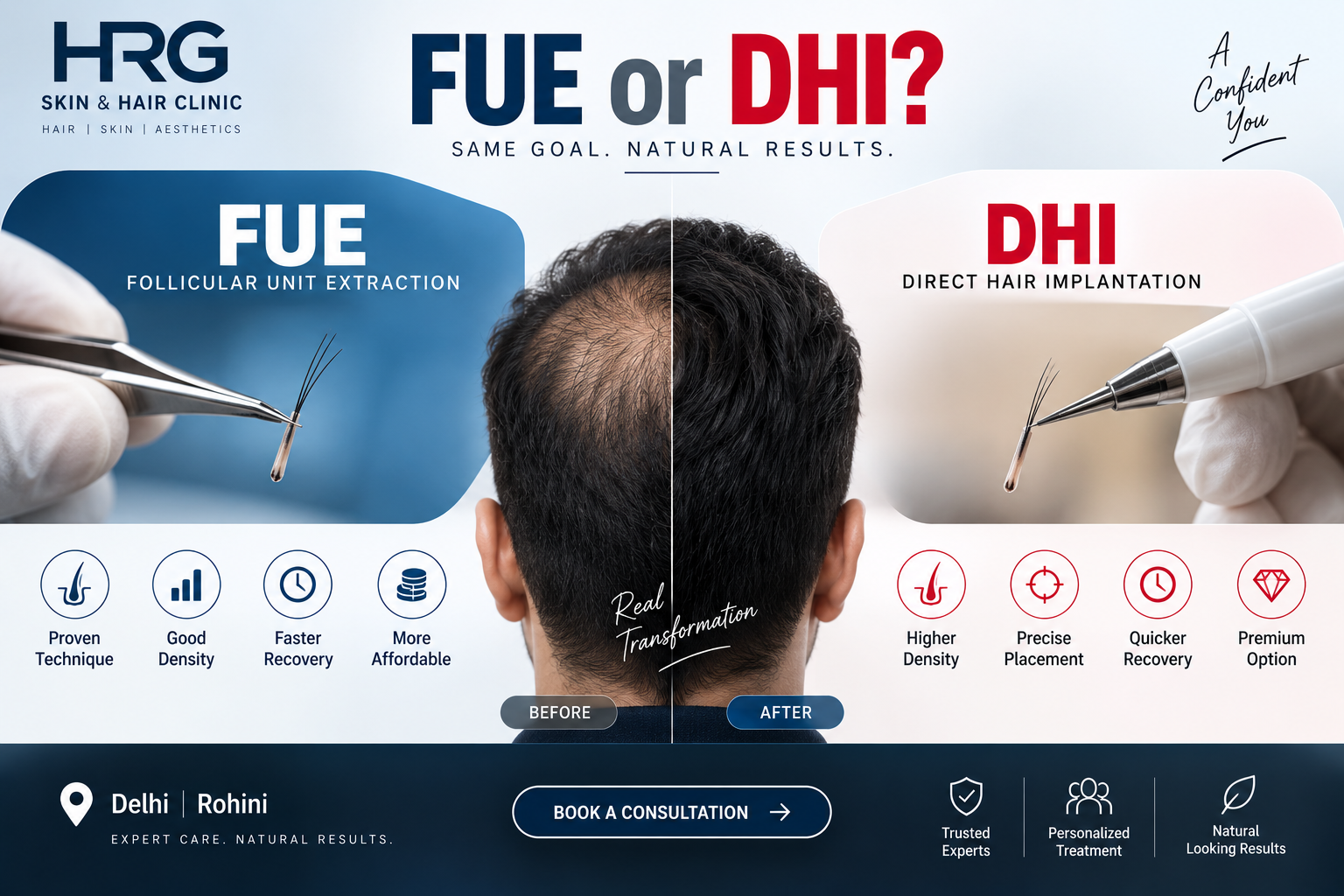
This is where the FUE vs DHI debate gets interesting. Implanter pens used in DHI can reduce direct forceps contact during placement, but the graft still has to be loaded into the pen. In the end, the operator's skill and care matter more than the device.
4. Transection rate and punch size
During FUE extraction, a tiny circular punch frees each graft. Hair roots under the skin do not grow perfectly straight, so if the punch angle is wrong, it can cut through the root. This is called transection. A transected graft may grow poorly or not at all, and that donor follicle is wasted for good.
FUE punches are commonly under about 1 mm wide. Smaller punches leave smaller scars, but a punch that is too small for your hair can strip the protective tissue around the graft or cut the root. A good surgeon chooses punch size for your hair, not for marketing.
- Curly or wavy hair: roots curve under the skin, so transection risk is higher and technique matters more.
- Very fine hair: grafts are fragile and easier to damage.
- Thick, straight hair: usually easier to extract cleanly.
Question to ask: "Will you check the first grafts under magnification and adjust the punch or angle if roots are being cut?"
5. Who actually does which step
This is the single biggest difference between clinics, and the hardest to see from outside. Some steps decide your result far more than others.
| Step | Impact on result | Who should do it |
|---|---|---|
| Diagnosis and planning | Very high | The doctor |
| Hairline design | Very high | The doctor |
| Graft extraction | Very high (transection, donor look) | The doctor, or under direct doctor control |
| Recipient sites (angle, direction, depth) | Very high (naturalness) | The doctor |
| Graft sorting and storage | High (survival) | Trained team, supervised |
| Graft placement | High (handling damage) | Doctor with trained team |
| Aftercare and follow-up | High | Doctor and clinic team |
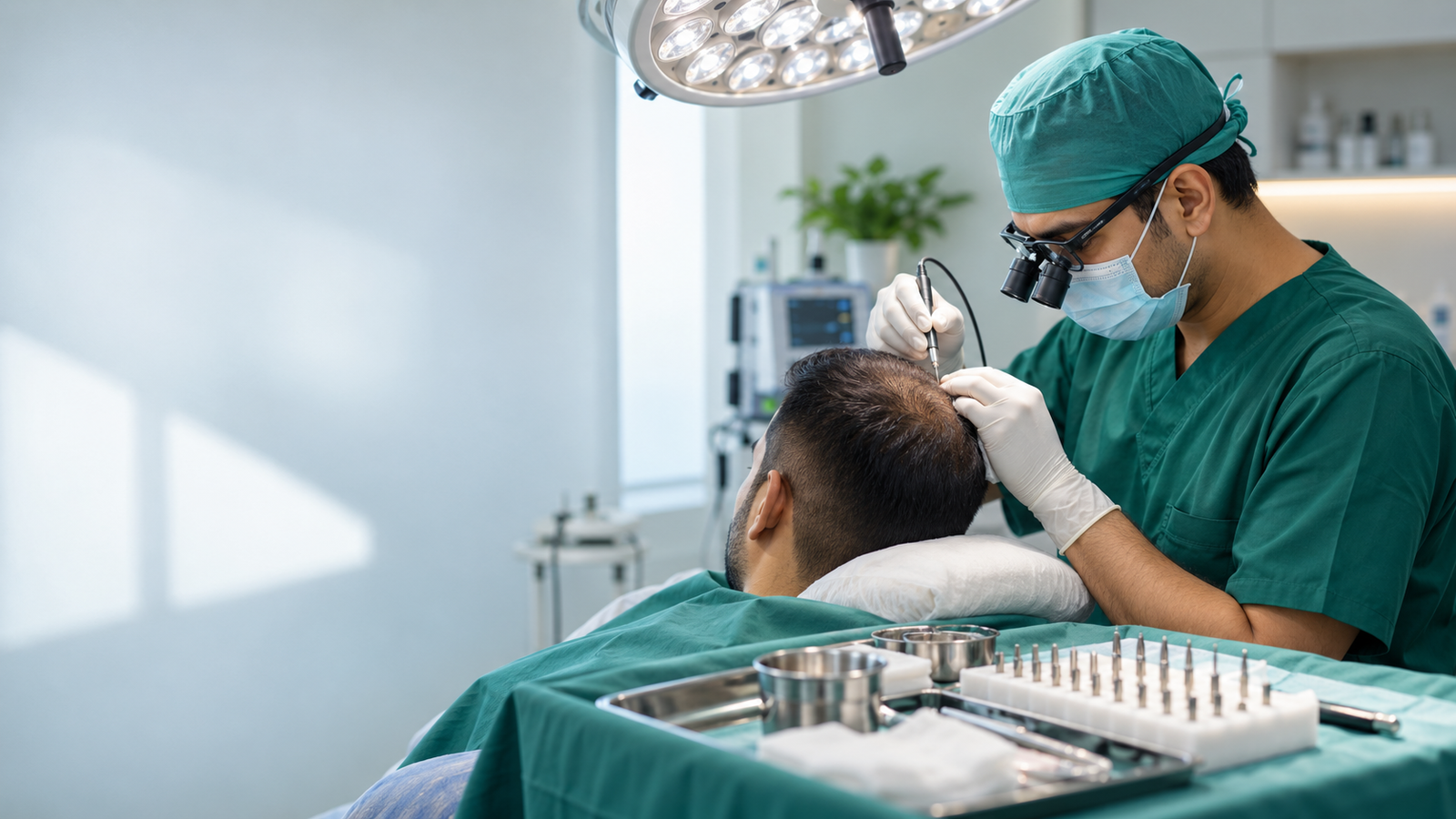
When people search for the best hair transplant surgeon in Delhi, they usually look at the doctor's photo on a website. The better question is how much of your procedure that doctor will do personally. A hair transplant is surgery and should be performed under a registered medical practitioner who is present and involved. Our guide on 7 questions to ask before any hair transplant covers how to verify this.
6. Density and the dense packing trap
A transplant does not need to copy your original density to look full, because the eye sees fullness long before that point. Hair usually starts to look thin only after a large share of the original density has already been lost.
Some clinics promise "maximum density" by packing grafts very close together. The recipient area has limited blood supply, and grafts packed too tightly may compete for it, which can reduce survival. Very dense packing in one session also burns through donor grafts quickly.
- The front hairline gets the most careful, denser placement because it frames the face.
- The mid-scalp and crown can often look full at a lower density, depending on hair thickness and colour.
- Thick, wavy or salt-and-pepper hair gives more visual coverage per graft than fine, black, straight hair.
Watch out for: "We will give you 70-80 grafts per square centimetre everywhere."
7. Your lifetime donor budget
This is the topic almost no one writes about, and the one that protects you most. The donor area at the back and sides of your head has a limited number of follicles that are usually resistant to pattern hair loss. Once a follicle is taken, it does not grow back there.
Think of it as a bank account you can only withdraw from. Hair loss often keeps progressing for years after a transplant (see our Norwood scale guide). If a clinic withdraws too much in your twenties to give you a teenage hairline, you may have nothing left when your crown thins at forty.
Signs of over-harvesting:
- The back of the head looks see-through or patchy, especially with short haircuts.
- Many tiny white dots are visible across the donor area.
- Grafts were taken from outside the safe zone, where hair may fall later anyway.
What good donor planning looks like: donor density measured before any graft count is promised, extraction spread evenly across the safe zone, a plan that considers your age and family history, and medical treatment such as PRP therapy or doctor-prescribed medication to protect the native hair you still have.
8. Graft count vs hair count: the pricing trick
A graft is one follicular unit. On average, Indian patients have around two hairs per graft, though this varies. So:
| Graft count | Approximate hair count |
|---|---|
| 1,000 grafts | About 2,000 to 2,500 hairs |
| 2,000 grafts | About 4,000 to 5,000 hairs |
| 3,000 grafts | About 6,000 to 7,500 hairs |
| 4,000 grafts | About 8,000 to 10,000 hairs |
If one clinic quotes "5,000 hairs" and another quotes "2,500 grafts", they may be offering the same procedure. Some advertisements use hair count because the number looks bigger. When you compare hair transplant cost in Delhi, always ask for the price in grafts, written on your quote.
9. Your own health and habits
Not every outcome is in the clinic's hands. Your body has to accept and nourish the grafts. Your doctor should review these before surgery:
- Smoking: reduces blood flow to the skin and can affect healing and growth. Most doctors ask you to stop around the procedure.
- Blood sugar and blood pressure: should be well controlled before surgery. Tell the doctor about any condition you have.
- Medicines and supplements: some affect bleeding. Never stop or start anything without your doctor's advice.
- Cause of hair loss: not all hair fall is pattern baldness, and some types do not respond to a transplant at all. A proper diagnosis comes first.
- Aftercare: sleeping position, washing and avoiding pressure on grafts protect them in the first days. See our recovery timeline.
How many grafts might you need? (Norwood stage guide)
Use this as a rough guide to make sense of quotes. Your exact number can only come from an in-person examination of your scalp and donor area. Read more in how many grafts do I need.
| Norwood stage | What it looks like | Typical graft range |
|---|---|---|
| Stage 2 | Slight temple recession | 800 to 1,500 |
| Stage 3 | Deeper temple recession | 1,500 to 2,200 |
| Stage 3 Vertex | Recession plus crown thinning | 1,800 to 2,600 |
| Stage 4 | Front and crown thinning | 2,200 to 3,000 |
| Stage 5 | Larger bald area, thin bridge | 3,000 to 4,000 |
| Stage 6 | Front to crown bald | 4,000 to 5,500, often in two sessions |
| Stage 7 | Only a band left at back and sides | 5,000 to 7,000, depends fully on donor |
Your graft survival checklist
Screenshot this and ask at every consultation:
- Who extracts grafts and makes the recipient sites?
- Do you extract and implant in batches? What is the longest any graft waits?
- What solution are grafts stored in, and how is it kept cold?
- Will you check transection on the first grafts and adjust if needed?
- Is my quote in grafts or hairs, and is it written down?
- How much donor will be left for a future session?
- What density will you place in each zone, and why?
- What health checks do you need before surgery?
Know someone comparing clinics? Send this checklist on WhatsApp.
How we protect graft survival at HRG Clinic, Rohini
We wrote this guide because these are the factors that decide your result, and you deserve to know them before you choose any clinic, including ours. At HRG Clinic in Sector 11, Rohini:
- The doctor performs your transplant personally, not technicians.
- Surgery takes place in a hospital-attached OT with emergency support.
- A full trained team handles graft sorting, storage and placement under supervision.
- Your donor area is planned for the long term, not just this session.
- You get ongoing follow-up through the full growth period.
- EMI options are available, so cost does not push you towards a riskier choice.
If you are looking for the best hair transplant clinic in Rohini or the best hair transplant in Delhi, we are easy to reach from Pitampura, Shalimar Bagh, Prashant Vihar, Paschim Vihar, Model Town, Bawana, Narela, Janakpuri and across North and West Delhi. You can also see our before-and-after results.
Frequently asked questions
What is a good graft survival rate in a hair transplant?
In a well-run procedure, most transplanted grafts are expected to grow, and experienced surgeons commonly aim for survival of around 90% or higher. Survival drops when grafts stay out of the body too long, dry out, are crushed by forceps or are cut during extraction.
How long can hair grafts stay outside the body?
There is no single safe number, but survival is best when grafts are implanted quickly and kept cold and moist in a holding solution while they wait. Long gaps between extraction and implantation are linked with lower survival, which is why careful clinics work in batches.
What is the difference between graft count and hair count?
A graft is one follicular unit and usually holds one to four hairs, with an average of roughly two. So 2,000 grafts can equal around 4,000 to 5,000 hairs. Always compare clinics on graft count.
Why do two people with the same graft count get different results?
Because the number of grafts extracted is not the number that grows. Out-of-body time, storage, handling, transection, density planning and the patient's own health all decide how many grafts survive.
Who should perform the hair transplant, the doctor or technicians?
The critical steps of hairline design, extraction and making recipient sites decide your result, and they should be done or directly controlled by a registered doctor. At HRG Clinic Rohini, the doctor personally performs the procedure.
Can my donor area run out?
Yes. The safe donor zone has a limited number of follicles over your lifetime. Taking too many in one session can leave the back looking thin and reduce options for future sessions.
Which is the best hair transplant clinic in Rohini, Delhi?
The best clinic is one that can clearly explain who performs each step, how grafts are stored, how your donor area is planned for the future and what follow-up you get. HRG Clinic in Sector 11, Rohini offers doctor-performed transplants, a hospital-attached OT, emergency support, EMI options and ongoing follow-up.
Do I need medicines after a hair transplant?
Transplanted hair is usually resistant to pattern hair loss, but your native hair can keep thinning. Many patients are advised medical treatment to protect it. Your doctor will decide what suits you, so do not start any medicine on your own.
Book your consultation in Rohini
Bring the checklist above. Ask us how we handle every graft. You will leave with your graft count, donor plan and total cost on paper.
HRG Clinic
1st Floor, C-1/167, Opposite CNG Pump, Sector 11, Rohini, Delhi 110085
Email: support@hrgclinic.com
Related reading
- 7 questions to ask before you book any hair transplant
- FUE vs DHI: which one is actually better for you?
- Hair transplant cost in Delhi: what actually decides the price
- How many grafts do I need?
- Hair transplant recovery: month-by-month timeline
This article is for general information and does not replace a medical consultation. Graft numbers, results and suitability for a hair transplant can only be confirmed after an in-person examination by a qualified doctor.